South Africa's sovereignty and constitutional democracy have been hard-earned. Its beauty and abundance of natural resources and diverse cultural heritage are precious to us.
Our potential for higher prosperity is immense and limited only by those in authority who consciously choose to abuse their power, joined by those who stand by and choose not to take action.
Corruption and cronyism are the products of leadership distracted by greed and matters of self-interest.
Silently and steadily, they carve away at our nation's soul. They disempower the poor of their rights and receipt of decent education, employment, health, water, housing and security.
We, the people, society and business, have two choices:
We can look away and do nothing.
Or we can take action and halt the decay.
At OUTA, we choose to take action.
We do so – without fear – through a focused strategy and motivated team that holds accountable those in authority who ignore their responsibilities and run roughshod over our constitutional values.
Holding government accountable
Vision, mission and values
Our core statements
We exist to halt the abuse of power and mismanagement of public resources that weaken the government's ability to serve the people. We are driven by a deep sense of justice, accountability and citizen empowerment to stop the decay, restore trust and drive meaningful and positive change in South Africa.
A South Africa where the government is well-run, public resources are used efficiently and corruption is addressed. A nation where democracy is strong, power is focused on the needs of the people, where governance prioritises accountability, transparency, fairness and human dignity.
We investigate and expose the abuse of power, engage with authorities to drive accountability, and mobilise society through strategic communication, thought leadership and advocacy. We challenge wrongdoing through legal and civil action, compelling changes in governance and influencing policy to build a more just, transparent and effective democracy.
Our core values

Why: To ensure that we maintain credibility and moral authority in our mission.
How: Operate transparently, adhere to ethical principles and hold ourself accountable to the same standards we expect from others.

Why: Advocacy against maladministration and corruption often involves taking bold stands against powerful entities.
How: Be fearless in exposing wrongdoing, standing firm in the face of opposition and pursuing justice even under pressure.

Why: The ultimate goal is to restore fairness and equity in governance and public administration.
How: Focus on outcomes that promote accountability, fairness and equitable use of resources for all citizens.

Why: Advocacy against maladministration often involves prolonged challenges and resistance from entrenched powers.
How: Stay persistent in the face of setbacks, adapt strategies to changing circumstances and remain steadfast in pursuing long-term goals.
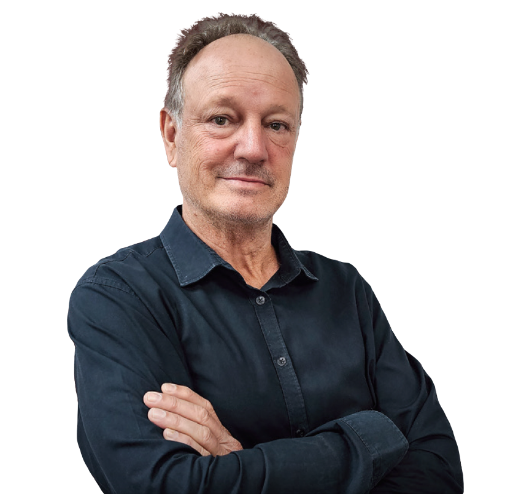
"We restructured our accountability and communications teams for improved focus and productivity."
Wayne Duvenage Chief executive officer
South Africa is not short of laws designed to protect public resources and ensure accountable government, but it is short of consistent enforcement.
Too often, those entrusted with public power do not face consequences for not only unlawful actions, but also gross maladministration and substantial waste of state funds. Processes are bypassed, oversight is weakened and in many cases the public only becomes aware of these failures once the damage has already been done and the money is lost.
We have seen this pattern play out over many years, across different administrations and institutions. Only the detail changes. What remains is the absence of accountability.
This is the terrain we operate in, because we choose to defend our hard-won democracy from the ravages of maladministration and corruption.
Over the past year, we have repeatedly seen how deeply embedded governance failures permeate across multiple areas of the state.
Across different sectors and institutions, the same underlying problems keep surfacing.
This directly flows into failing infrastructure, declining service delivery and growing frustration among South Africans who carry the cost or deal with lack of consistent water supply, degradation of roads and rail transport options, waste management and more. Large infrastructure projects and reforms like the failed Road Accident Fund are delayed for years. Corrective action remains slow, even when problems have been clearly identified.
In each case, the costs mount and society bear them.
While the extent of corruption and maladministration remains widespread, we know that every effort in this space counts and makes a difference with varying positive outcomes.
Collectively, billions of rand are saved and accountability is enforced where errant leadership would have been allowed to remain ensconced in their positions.
The most important people in the anti-corruption ecosystem are whistleblowers, who provide valuable information in our investigations. They are the heroes who risk their lives and livelihoods, exercising their moral courage to seek accountability and place barriers in the way of corruption and maladministration. During the process, we also engage with those in authority who are willing to listen, and those who choose to work with us to introduce corrective measures. Where our efforts and concerns are disregarded, we escalate the issues, to the attention of those higher up the chain of command, other oversight bodies and society at large.
This work requires time and persistence, careful analysis, focus and in many cases, the willingness to engage on matters through the courts. Our experiences have shown that when focused pressure is applied, change can and does happen.
At the start of Q1 of 2025, we took a step back and reflected on our work, effort, impact and alignment with our purpose. This strategic exercise required us to ask difficult questions about our role and capacity constraints. We recognised that while we had remained true to our core focus areas of challenging corruption, maladministration and irrational government policies, we had also ventured into other initiatives with good intentions (such as water quality reporting, smart city applications and local government performance reporting). However, each of these other initiatives required additional resources and attention, which was becoming costly to support and a deviation from our core focus and purpose.
We made a tough decision to hive off or cease some of these projects and assisted in the launch of separate non-profit organisations (NPOs) for three of these initiatives (WaterCAN; JoburgCAN and the Community Action Network – CAN), while also providing limited financial support and back-up services. At the same time, we closed the municipal infrastructure reporting app (Link).
In addition, we restructured our accountability and communications teams for improved focus and productivity, which required us to go through a painful retrenchment process. The overall result was that after starting out in 2025 with 44 staff, we closed the year with 33 positions and a flatter structure, enabling a sharper and more focused team, concentrated on our core work.
While these were not easy decisions, they were very necessary. The outcome has been extremely positive on the organisation's energy and focus on its core mandate of challenging systemic failures in governance, largely at a national level. At the same time, the reduced costs have helped us become more sustainable over time.
Before our restructuring decision, we opened the 2025/26 financial year with 50 projects in progress. Our decision to move our local government and water projects to their new separate domains, along with a focus on our core mandate projects, enabled us to close 45 projects throughout the year, while opening another 24. This has left us with a more manageable workload of 29 open projects going into the new financial year.
Our manpower costs reduced by almost 9% on the prior year and overall operating expenses were down by 4%, as most of the headcount cost reductions took place in the second quarter, while our support to cover WaterCAN's budget continued throughout the financial year. Most of our cost containment measures will provide relief in the coming financial year.
This annual report contains significant input and updates on several projects undertaken by us. We continued to work on inefficiencies, maladministration and corruption in the higher education space, because it is in this space that so much has gone wrong over many years within the Sectoral Education and Training Authorities (SETAs) and the National Student Financial Aid Scheme (NSFAS). In addition, the uptake and action undertaken at NSFAS has been positive on account of our reports on the student accommodation scams and irregularities.
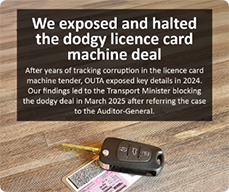
Two other areas of attention have been in the transport and energy sectors. We were pleased to see the final court order to reverse the tender of the driving licence card machine contract, during which we, assisted by whistleblowers, were able to expose the gross irregularities of that tender. Our report pertaining to corruption and gross irregularities in the vehicle testing station sector has been encouraging, and a civil society and industry engagement with the Department of Transport is expected in the new year.
An important project that gained traction during the year pertained to Eskom's handling of its demands related to small-scale embedded generation (SSEG) systems, also referred to as residential solar and battery energy storage (SV-BES) installations. We were pleased to see Eskom change its approach to some of their conditions, however, this project continues to unfold into the new year, with significant disparity between municipalities and the national laws that govern these processes. We believe that the conduct and irrational processes being applied by Eskom and municipalities on the SSEG registration and permissions issue has become extremely damaging and confusing to society, as well as the SV-BES industry.
Another reality that we have had to confront is the growing difficulties of funding and the "donor fatigue" environment that civil society organisations are facing.
South Africans are under financial strain. Households are being forced to make more difficult choices. Businesses are operating under pressure. This inevitably affects the ability of many of our supporters to contribute financially to civil action organisations. At OUTA, we have been fortunate to have a few corporate entities that realise the importance of defending our democracy against the ravages of corruption and maladministration. Their support has largely, but not entirely, offset the decline in support from our wide base of individuals who give us an average donation of R125 per month.
At the same time, the demand for our work is increasing, more matters require investigation, more cases require legal intervention, more sustained pressure is needed to ensure issues are not allowed to fade from public attention.
In simple terms, the need for accountability and transparency is growing, while the resources available to support our work are under pressure and that tension is real.
We do not operate in isolation. Our work is sustained by those in society who choose to be engaged, often despite their own constraints. People who follow the issues and question why our national prosperity levels remain constrained. These are the people who support this important work because they understand why it matters.
That support is not something we take for granted. We know all too well that it must be earned and maintained.
It is this community of engaged citizens that enables us to remain independent, focused and willing to take on difficult matters that others may choose to avoid.
We closed the year with
33 positionsand a flatter structure,enabling a sharper and more focused team.

We are not expecting the environment to ease in the year ahead. Unfortunately, governance failures will continue to emerge and pressure on public resources will remain high. The need for independent oversight and civil action to curb the abuse and waste of state funds remains high.
There will be new matters, new whistleblower engagements, new challenges and areas where civil intervention is required.
Our role is to remain focused and deliberate in how we respond.
This is not work that produces immediate results, but over time, sustained pressure does make a difference. It creates visibility, it strengthens oversight, and in some cases, it leads to decisions being reversed and systems being improved, even if it is limited to those areas where civil action organisations get involved. That is what we are here to do.
Because without consistent pressure, accountability and corrective action do not follow. And when accountability does not follow, the cost is carried by the public.
1 March 2025 to February 2026
Our Accountability Division investigates corruption, challenges unlawful decisions and advocates for stronger governance and oversight.
Accountability projects
Total projects active at close of the year
Projects completed or concluded
New projects opened during the reporting period
Projects closed as successful
Examples include the Karpowership electricity licence judgment, the overturning of the driving licence card machine tender and the repeal of Johannesburg's CCTV by-law.

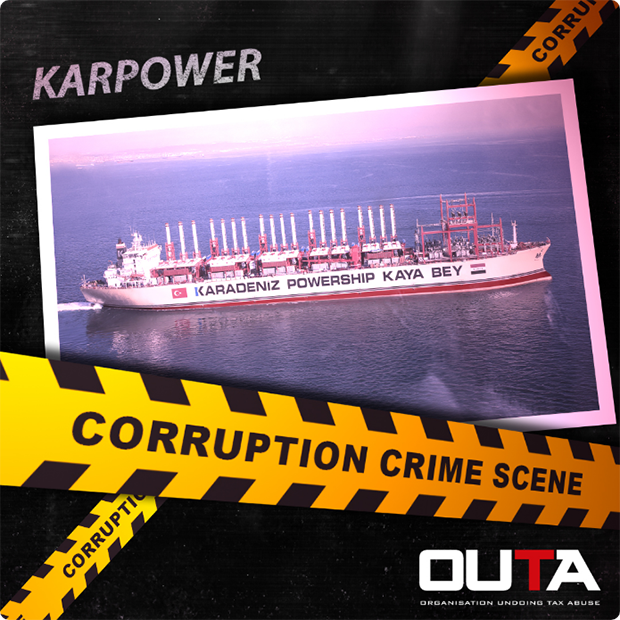
OUTA wins legal challenge against Karpowership plan
On 31 July 2025, we won a landmark legal challenge that overturned the electricity generation licences granted to three Karpowership projects. This action took three years and effectively ended the state's plans to procure power from floating gas-powered power ships owned by Karpowership.
Funding model and financial credibility
still in progress
increase in operating expenses (excluding staff costs)
decrease in deposit yields
surplus for the year
The 2025/26 produced a very similar financial performance to the prior year, with more growth in the corporate donor segment, compensating for a slight decline from our crowd funded income stream (individuals and SMMEs), who are feeling the weight of a tougher economic environment. Large companies are now realising the importance of donating to organisations that fight corruption and maladministration in South Africa, doing so through their corporate social investment (CSI) allocations. This also enables donors to obtain a partial tax relief, due to OUTA's section 18A Public Benefit status.